
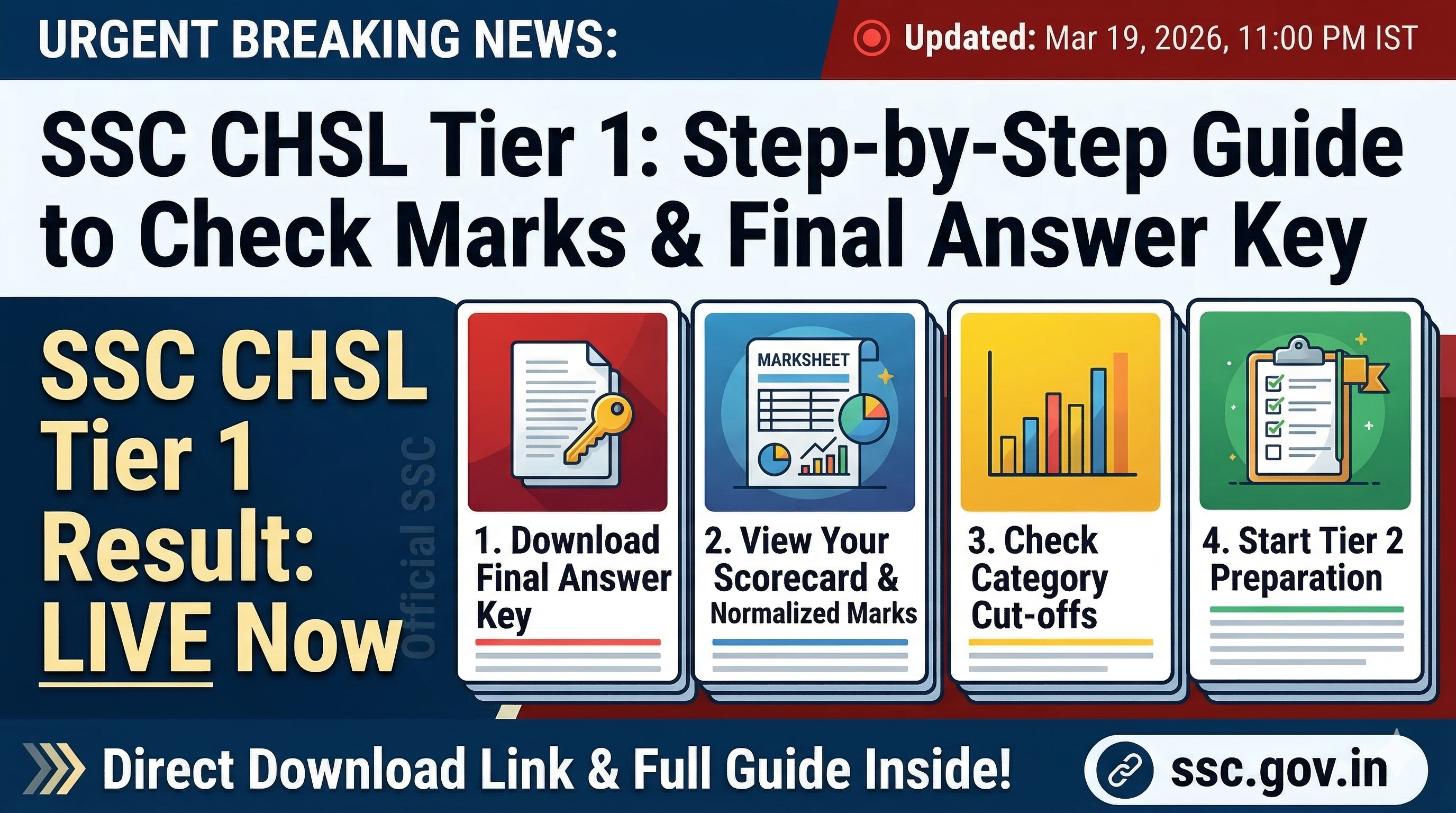
The Staff Selection Commission (SSC) has made a significant announcement that has been eagerly awaited by thousands of candidates across India. The official SSC CHSL Tier 1 Scorecard 2026 and the Final Answer Key are now available for all candidates who appeared for the Combined Higher Secondary (10+2) Level Examination. This is the moment to verify your performance, check your section-wise scores, and understand the impact of normalization on your marks.
If you are an aspirant who took this exam, your results are just a few clicks away on the official portal, https://ssc.gov.in. This extensive guide provides everything you need to know about downloading your scorecard, analyzing your marks, understanding the cut-off breakdown, and preparing for the critical next steps in your government exam journey.
📊 SSC CHSL 2025-26 Recruitment Cycle: Key Highlights
Let’s first take a quick glance at the major details of the SSC CHSL 2025-26 recruitment cycle to put this update into context.
| Information Head | Details |
| Exam Name | SSC Combined Higher Secondary (10+2) Level Exam 2025-26 |
| Conducting Authority | Staff Selection Commission (SSC) |
| Tier 1 Exam Dates | Conducted in multiple shifts in early 2026 |
| Official Website | ssc.gov.in |
| Scorecard Status | LIVE (March 19, 2026) |
| Final Answer Key Status | LIVE (March 19, 2026) |
| Availability Date | Marks are visible for a limited time (typically ~1 month). |
| Credentials Required | Registration Number & Password |
Crucial Tip for Aspirants: Download and save your scorecard and response sheet IMMEDIATELY. SSC will remove these links after the specified period (likely April 18, 2026). You will not be able to access them after that, and you will absolutely need them during the Document Verification (DV) stage.
🚀 How to Check SSC CHSL Tier 1 Scorecard 2026 @ssc.gov.in? (Step-by-Step)
The Staff Selection Commission has introduced a new official website interface, which may be confusing for some. Follow these clear, detailed steps to successfully check and download your scorecard:
Step 1: Visit the New Official Portal
Navigate to the official SSC website: https://ssc.gov.in. Make sure you use a modern browser like Google Chrome, Mozilla Firefox, or Safari for a stable connection.
Step 2: Access the Login Panel
On the right side of the homepage, find the ‘Login or Register’ section. This requires your credentials from the OTR (One-Time Registration) system.
Step 3: Enter Credentials & Captcha
Enter your Registration Number and the Password you set during your registration. Carefully enter the alphanumeric Captcha Code to verify you are not a bot. Click the ‘Login’ button.
Step 4: Go to Results & Marks Section
Once you are logged into your candidate dashboard, look for the ‘Result/Marks’ tab. Click on it to open the selection menu.
Step 5: Select the Correct Examination
A dropdown list will appear. Select the exam name: ‘Combined Higher Secondary (10+2) Level Examination, 2025’ from the list of results currently active.
Step 6: Submit and View Your Marks
Click the ‘Submit’ button. Your comprehensive scorecard, displaying detailed section-wise marks, raw score, and, most importantly, the Normalized Score, will be displayed.
Step 7: Print or Download
Always save your marksheet as a PDF. Look for a ‘Print’ or ‘Download’ button and keep a copy safely in your digital files.
🔍 Understanding the Importance of the Final Answer Key vs. Scorecard
Many students wonder why the Final Answer Key and the Scorecard are released on the same day. Here is the critical link between the two:
Transparency and Verification: When you see your final marks, you need to be able to verify that the calculation is correct. By providing the Final Answer Key along with your Response Sheet (a record of your choices during the exam), SSC allows you to cross-verify every question.
Finality: After the initial exam, SSC releases a “Provisional Answer Key” and invites students to file objections. An expert panel reviews these objections. The resulting key is the Final Answer Key. No further changes or objections can be made. This is the official key used to calculate every mark.
Correcting Discrepancies: This key ensures that any flawed questions, or questions with ambiguous options, are either corrected or the marks are awarded to all candidates in that shift, ensuring fairness.
Why you should check it: Even if you think you didn’t qualify, review the Final Answer Key. A simple change in one or two questions can shift multiple candidates’ fortunes, and knowing which answers were updated gives you an edge in future exam attempts.
How Normalization Affects a Candidate:
Easy Shifts: If your shift was categorized as ‘Easy’ relative to other shifts, your score might increase only a small amount, or, in some cases, slightly decrease.
Hard Shifts: If you faced a particularly difficult set of questions, your normalized score will be significantly higher than your raw score (sometimes by 10-15 marks or more).
The Bottom Line: Don’t obsess over raw scores. Wait for the normalized marks. High accuracy is generally your best friend across all difficulty levels.
📉 Category-Wise Expected Cut-off Analysis 2026 (Tier 1)
While the official cut-off list will be available in the detailed notification PDF on the ssc.gov.in website, we provide a reliable, category-wise expected cut-off range based on detailed analysis of shift difficulty, vacancies, and initial student feedback.
| Category | Estimated Normalized Cut-off Range |
| General (UR) | 153.5 — 158.0 |
| OBC | 150.0 — 154.5 |
| EWS | 146.5 — 151.0 |
| SC | 130.0 — 136.0 |
| ST | 120.5 — 126.5 |
| ESM (Ex-Servicemen) | 100.0 — 105.0 |
| PwD (OH) | 132.0 — 138.0 |
| PwD (HH) | 90.0 — 96.0 |
Disclaimer: These are estimated figures. Please refer to the official Staff Selection Commission website and the finalized result notification PDF for official cut-off marks.*
Analysis Notes: The cut-off for SSC CHSL Tier 1 is consistently high due to the qualifying nature of Tier 1. The focus is purely on crossing this normalized threshold to move forward.
💡 What Details to Verify on Your Scorecard
Don’t just look at the final number. Diligently check the following details on your downloaded scorecard to ensure everything is correct:
✅ Candidate Name and Roll Number: Ensure these match your application exactly.
✅ Category and Date of Birth: Discrepancies here can cause massive issues during document verification.
✅ Normalized Marks vs. Cut-off: Understand the difference and verify your qualification status.
✅ Subject-Wise Marks: Analyze your strengths and weaknesses. A breakdown like this is useful for long-term study planning:
English Language
General Intelligence and Reasoning
Quantitative Aptitude
General Awareness
🎯 Moving to Tier 2: A Strategic Roadmap
If your name is on the qualified list, congratulations But remember, Tier 1 is only qualifying. Tier 2 is where the actual selection battle takes place. Your Department Allocation and final merit depend entirely on your Tier 2 scores.
1. Master the New Sectional Weightage
Tier 2 has introduced a new pattern with distinct sectional timings. Don’t take any section lightly.
Mathematical Abilities & Reasoning: Both carry equal weightage. Practice difficult puzzles and data interpretation daily. Don’t just rely on speed, focus on accuracy for complex multi-step problems.
English Language: This section has the highest weightage in Tier 2. Read high-quality English editorials (like ‘The Hindu’ or ‘Indian Express’) and build strong grammar and vocabulary. Comprehension is key.
General Awareness: This is no longer optional. Focus on Current Affairs (last 6-12 months) and high-yield static topics (like Indian Constitution, Biology, and Physics).
2. Prepare for the Computer Knowledge Module (Crucial Qualification)
This is the silent killer that disqualifies many high-scoring candidates every year. While it is qualifying in nature, the cutoff is strictly enforced.
Key Topics: Basics of computers, Networking, Cyber Security, MS Office (Word, Excel, PowerPoint), and essential shortcuts.
Study Tip: Don’t just read about it. Use the applications. Solve previous year computer module questions from CGL and CHSL.
3. Start Typing Test Practice Immediately
The Typing Test (Skill Test) is often underestimated. It is qualifying in nature and will determine if your high Tier 2 score matters.
Speed Requirement: 35 words per minute (wpm) for English, 30 wpm for Hindi (with high accuracy).
Typing Tip: Practice on a standard physical keyboard. Don’t use your phone or tablet keyboard. Set aside 30 minutes every single day. Focus on keeping accuracy above 95% before you push for extreme speed.
🛠️ Handling Potential Discrepancies in Marks
If you find a clear error in the calculation of your marks, or if there is a massive difference (20+ marks) in your normalized score that cannot be justified by shift difficulty, you must act quickly.
Check official timelines: Look for a specified grievance redressal window mentioned in the official result announcement.
Contact Regional Office: SSC has multiple regional offices. Contact the office corresponding to your exam center. You can find contact details (phone, email) on the https://ssc.gov.in contact page.
Submit relevant proof: If you have it, submit a detailed cross-verification of your Response Sheet with the Final Answer Key to support your case.
🏁 Conclusion and Next Steps
The release of the SSC CHSL Tier 1 Scorecard 2026 is not just an update; it is the definitive moment that either confirms your qualification for the next phase or provides the essential data to plan your next attempt.
If you have made the list, your Tier 2 preparation must begin now. For those who didn’t qualify, don’t lose heart. Use your scorecard to analyze exactly where you fell short. Every competitive exam is a learning experience, and the data you now have is the key to building a stronger, smarter strategy for the next recruitment cycle.
Keep checking the official SSC portal for more updates on Tier 2 exam dates and further procedures.